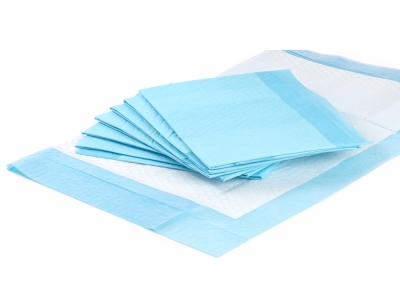
In incontinence care and the daily routine of bedridden patients, the disposable underpad is often viewed as a basic "sanitary" consumable, intended solely to protect sheets and mattresses from bodily fluid contamination. However, this traditional perception often overlooks the core value of underpads in clinical care—they are the first line of defense in maintaining patient skin integrity.
For patients confined to bed for long periods, moisture is the greatest enemy. This article analyzes, from the perspective of skin microclimate management, why choosing high-quality underpads containing Super Absorbent Polymer (SAP) is a critical decision in reducing the risk of Incontinence-Associated Dermatitis (IAD).
1. Core Technology: Not Just Absorbing, But "Locking"
Many low-end underpads rely solely on wood fluff pulp to absorb liquid. While fluff pulp absorbs quickly, it is prone to "rewet" when under pressure (such as when a patient lies on it). This "wet sponge effect" causes the patient's skin to be soaked in urine or body fluids for prolonged periods, leading to softening of the stratum corneum and compromised barrier function.
High-performance underpads utilize a hybrid core structure of "Super Absorbent Polymer (SAP) + Fluff Pulp." SAP is a functional material capable of absorbing liquids dozens or even hundreds of times its own weight and rapidly converting them into a gel. This change in physical state means that moisture cannot escape even under pressure. By firmly locking fluid in the bottom layer, the top sheet of the underpad remains dry, effectively cutting off the physical source of skin maceration.
2. Diamond Embossing and Flow Design: Micro-Engineering of Fluid Management
If you look closely at a premium underpad, you will notice the surface is often covered with diamond or patterned embossing. This is not for aesthetics; it is part of the fluid diversion system.
If liquid concentrates in a single spot, it can easily lead to local saturation and overflow. The embossed design guides the liquid to spread rapidly across the surface, utilizing the entire area of the pad for absorption. This rapid distribution mechanism ensures that no single area remains overly wet for long, effectively reducing the time window of contact between urine and skin.
3. Nursing Economics: Do Cheap Underpads Really Save Money?
In the procurement process, the price per unit is often the primary consideration. However, from the perspective of total lifecycle care costs, cheap, thin underpads are often "hidden money pits."
Frequency of Change: Insufficient absorbency means caregivers must change the pads more frequently, increasing the workload for nursing staff.
Complication Costs: Once a patient develops pressure ulcers or dermatitis due to inferior underpads, the subsequent costs for treatment, medication, and extended hospital stays will far exceed the price difference of the pads themselves.
High-quality underpads typically feature a five-layer design (Non-woven top sheet, tissue paper, Fluff pulp + SAP, tissue paper, PE leak-proof back sheet). Their superior absorption capacity allows for longer usage intervals. This not only affords patients more continuous, undisturbed rest but also substantively lowers daily consumable expenditures.
Conclusion
When we re-examine a seemingly simple disposable underpad, we should see a protection system integrating fluid dynamics and materials science. In modern nursing, it is no longer just a shield for bedsheets, but a guardian of patient skin health. Choosing underpads with scientifically configured SAP content and rational structural design maintains patient dignity and reflects the professionalism of the medical institution.