In strictly controlled cleanrooms or operating room environments, the primary source of contamination is often not the equipment, but the people. Although medical staff undergo rigorous hand scrubbing and don sterile gowns, the head and face area can often become a "blind spot" for microbial shedding.
Many people believe that wearing a disposable medical cap is simply to prevent hair from falling into the wound. While this is true, it is only the tip of the iceberg. This article explores why choosing high-quality disposable medical caps is one of the most cost-effective lines of defense in reducing Surgical Site Infection (SSI) rates.
1. Blocking the "Particle Rain": Controlling Bacterial Vectors at the Source
The human body sheds thousands of skin flakes every minute, and the hair and scalp are natural reservoirs for bacteria (such as Staphylococcus aureus). If the head is not properly covered during surgery, or if the pore size of the cap material is too large, tiny skin flakes carrying bacteria can drift like invisible "particle rain" into the sterile field.
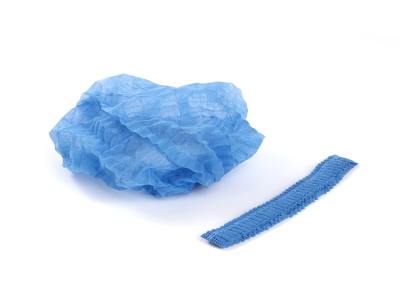
Professional disposable medical caps are typically manufactured from high-quality Polypropylene (PP) Spunbond Non-woven fabric. The intricate fiber structure of this material forms a physical barrier. It does not merely cover visible hair; more importantly, it effectively "filters" and traps micro-dust and dander generated by the scalp, preventing them from migrating to the patient's open wound via air convection.
2. Breathability: Not Just About Comfort, But Sterility
You might ask, if the goal is isolation, why not wear a completely sealed plastic cap? This involves heat and moisture management.
If the cap is not breathable, the heat and sweat generated by the medical staff's scalp cannot escape, leading to perspiration on the forehead. Once sweat drips, or if itchiness causes the staff to subconsciously lift their hand to touch their head, sterile principles are instantly compromised. Therefore, the material of a high-quality medical cap must possess excellent air permeability. It needs to allow heat to dissipate while maintaining particle barrier efficiency, ensuring that surgeons remain dry and comfortable during hours-long procedures, thereby reducing operational risks caused by physiological discomfort.
3. The Secret of Elastic Design: Single or Double?
Common disposable bouffant caps on the market typically feature either a single or double elastic design at the rim. This is not just a difference in cost, but a trade-off between sealing capability and comfort.
Cheap single-elastic designs often have uneven pressure distribution—either too tight, causing forehead indentations and headaches, or too loose, allowing the hairline edge to slip during vigorous movement. For female medical staff with long hair or greater hair volume, medical caps with a Double Elastic design offer a softer yet more secure hold. This ensures that while covering all hair, the edge fits tightly against the skin without gaps, eliminating the possibility of contaminants "escaping" from the rim.
4. Conclusion
On the procurement list of medical consumables, disposable medical caps are often overlooked due to their low unit price. However, it is this thin layer of non-woven fabric that guards the "top" priority of aseptic operation. From the perspective of microbial control, a medical cap that is breathable, tightly sealed, and comfortable to wear holds value far beyond its price. It is not only a commitment to patient safety but also care for the occupational health of medical personnel.